
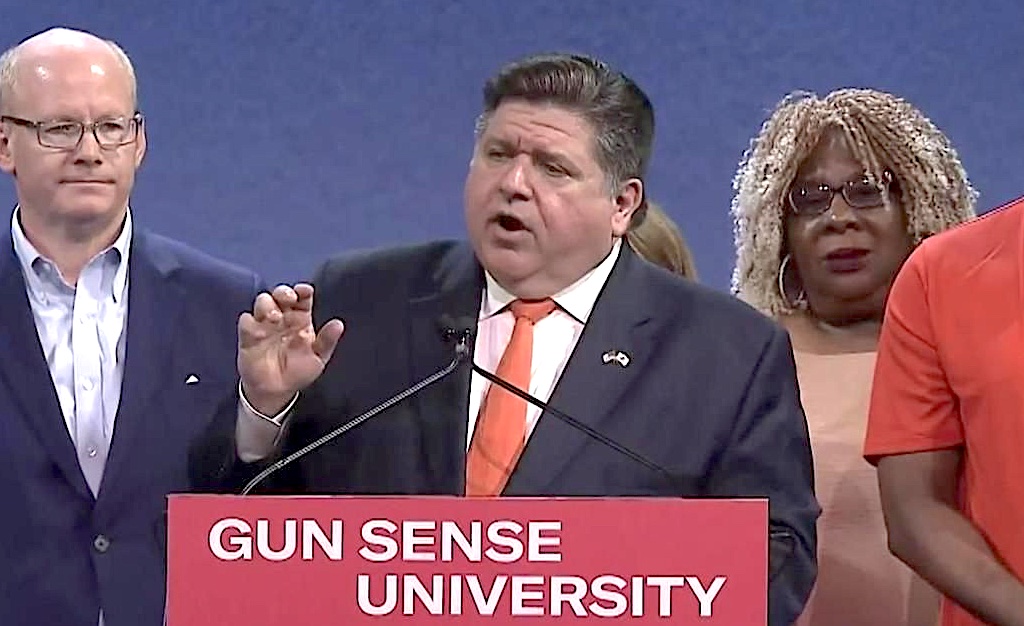
Gov. JB Pritzker signs new law allowing victims of gun violence to sue gun makers https://t.co/2cZcG6fdoc pic.twitter.com/fFaKC4jBfH
— CBS Chicago (@cbschicago) August 13, 2023
Over the weekend, Illinois’ rotund governor, who’s never seen an anti-gun bill he couldn’t support, signed a bill into law that’s designed to muzzle the free speech of gun manufacturers and retailers. He spoke before an adoring crowd of Second Amendment deniers at an Everytown civilian disarmament rally in Chicago over the weekend. He then signed a bill into law that prohibits commercial speech that can arbitrarily be determined to somehow appeal to children, “militants,” or others who might later use the weapons illegally (that means criminals for all of Chicago’s Brandon Johnson voters out there).
In other words, there’s no way for any gun maker or seller to adequately minimize their risk and reasonably comply with such a law short of stopping all advertising for firearms. And the language of the law doesn’t restrict its reach to only potentially problematic marketing materials within the Land o’ Lincoln. Illinoisans can sue for violations that take place in other states, too.
Today, the NSSF filed suit to block enforcement of the law, seeking to have it declared an unconstitutional violation of both the First and Second Amendment, in addition to violating the Protection of Lawful Commerce in Arms Act (read the complaint here).
From the complaint . . .
Under HB 218, the “sale, manufacturing, importing, or marketing of a firearm-related product” anywhere in the country may be deemed to violate Illinois law (and justify the imposition of sweeping liability), even if it complied with all state and federal regulations, if an Illinois judge or jury later finds that such conduct “contribute[d] to a condition in Illinois that endangers the safety or health of the public.”
Although the statute purports to be aimed at preventing firearms from being used in such a way that endangers public safety or health, HB 218 does not regulate the use (or misuse) of firearms. Nor does it impose liability on individuals who misuse firearms to the detriment of themselves or others. Instead, HB 218 regulates selling, manufacturing, and advertising lawful (and constitutionally protected) firearms and related products. In other words, HB 218 regulates commerce in and speech relating to arms—even when that commerce and speech takes place entirely outside of Illinois, as will often be the case. HB 218 also removes traditional elements of tort law that ensure that judges and juries do not impose liability on private parties for constitutionally protected conduct. Making matters worse, the statute jettisons traditional proximate cause in favor of allowing state courts to impose liability on licensed industry members for the actions of thirdparty criminals with whom the industry members never dealt.
None of that is consistent with the Constitution. The First Amendment prohibits states from punishing wide swaths of truthful speech about lawful products, even if the products are dangerous or the speech is unpopular. The Second Amendment protects commerce in arms. Numerous constitutional provisions prohibit states from regulating conduct that takes place wholly beyond their borders, even when that commerce has effects within the state. And the Due Process Clause prohibits states from punishing one private party for the conduct of another.
All of that is reason enough to invalidate Illinois’ new statute. But there is an even more obvious problem with HB 218: It is squarely preempted by federal law. In the late 1990s and early 2000s, several state and local governments sought to use novel applications of common-law theories like negligence and nuisance to impose civil liability on manufacturers and sellers of firearms and ammunition when third parties misused their products. Congress saw these lawsuits for what they were: unconstitutional efforts to stamp out lawful and constitutionally protected activity. To end such incursions, Congress enacted the Protection of Lawful Commerce in Arms Act in 2005 by wide margins on a substantially bipartisan basis. The PLCAA expressly prohibits and preempts state-law civil actions “brought by any person against a manufacturer or seller of [firearms or ammunition] … for damages, punitive damages, injunctive or declaratory relief, abatement, restitution, fines, or penalties, or other relief, resulting from the criminal or unlawful misuse of [firearms or ammunition] by the person or a third party.”
Here’s the NSSF’s press release announcing the lawsuit . . .
NSSF, The Firearm Industry Trade Association, filed a legal challenge to Illinois’ unconstitutional law that seeks to muzzle firearm manufacturers’ and retailers’ First Amendment right of free commercial speech and to regulate industry members’ commercial conduct in every state of the Union. Gov. J.B. Pritzker signed the Firearm Industry Responsibility Act into law and NSSF immediately filed its challenge.
“The flawed logic of this unconstitutional law is second only to the contempt for which the authors and Governor Pritzker hold for the Constitutionally-protected right of the citizens of his state to keep and bear arms,” said Lawrence G. Keane, NSSF’s Senior Vice President and General Counsel. “This law bans commercial free speech, which is protected by the First Amendment. It also requires firearm manufacturers and retailers to establish undefined ‘reasonable controls’ to prevent criminals from lying on background check forms. The irony is that the firearm industry works hand-in-hand with the ATF and Justice Department to prevent illegal straw purchases of firearms while the governor signs laws that set criminals free on the streets to prey on the innocent citizens of Illinois. Just like Governor Pritzker’s signature on a law banning cash bail, this law empowers criminals and punishes those who obey the law. We are confident that this unconstitutional law will not survive.”
Illinois’ Firearm Industry Responsibility Act criminalizes First Amendment-protected commercial free speech by banning advertising with vague definitions of “intent to appeal to minors.” Gun control politicians in Illinois are attempting to restrict law-abiding citizens from passing on safe firearm handling and shooting skills to the next generation by squelching ability to depict it in advertising. Only adults over the age of 18 can legally purchase a long gun and only adults over 21 can legally purchase a handgun.
This law also victimizes lawful firearm manufacturers and retailers for crimes committed by remote third parties. This law would allow lawsuits against firearm retailers for being the victims of “smash-and-grab” burglaries and robberies.
This law shifts the blame of responsibility for an illegal straw purchase from the criminal committing the crime to firearm manufacturers and retailers. The law requires manufacturers and retailers to employ ill-defined “reasonable controls,” yet each and every retail firearm purchase requires a Bureau of Alcohol, Tobacco, Firearms and Explosives (ATF) Form 4473 to be completed and signed by the purchaser attesting that the intended recipient of the firearm is, in fact, the purchaser. Lying on that form is a federal felony, punishable by up to 15 years in prison and a $250,000 fine.
The firearm industry partners with the ATF and the Justice Department on the “Don’t Lie for the Other Guy” program to warn the public of the punishment for this crime. Individuals flouting the law are responsible for their criminal actions and must be held accountable. No business can be held responsible for the illegal and criminal acts of those who consciously choose to violate the law.