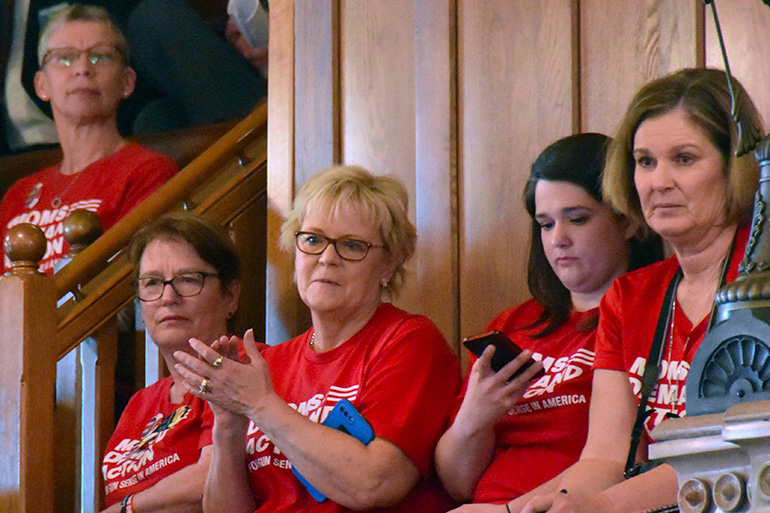
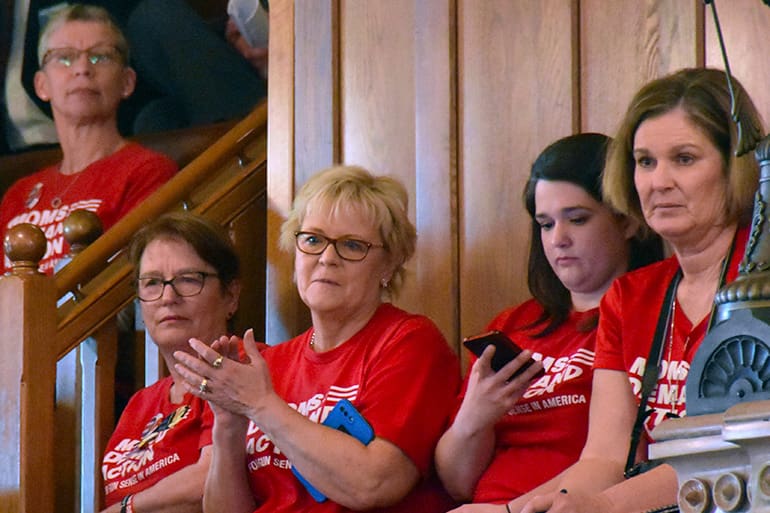
An article at slate.com yesterday details the efforts of a brace of red-shirted Moms Demand Action members who are “scouring archives across the United States for historical firearm regulations.” What they’re actually doing, author Mark Joseph Stern says, is trying to dig up proof that Justice Clarence Thomas was wrong in his Bruen opinion when he wrote that prior to 1900, carry restrictions weren’t part of America’s history and tradition.
In Bruen, the Supreme Court demanded proof that a firearm regulation is rooted in “longstanding” tradition in the form of “historical analogues”—old gun laws that show how Americans “understood” the Second Amendment in the past. The historical record of firearm regulations, however, is far from complete. So motivated volunteers like [Moms Demand Action member Jennifer] Birch, a product designer by trade, are stepping in to fill the gaps. What they’ve found directly contradicts the Supreme Court’s conclusions.
This is actually an article about how an organization funded by a billionaire is encouraging people to work for free for no reason. And when there’s a misleading article about the Second Amendment that confidently asserts nonsense, Mark Joseph Stern’s name is often on the byline.
Birch was surprised by what she found: Santa Ana prohibited the concealed carry of weapons, including guns, in 1892, while neighboring Anaheim followed suit in 1893. Orange County itself, in which both cities are located, had also prohibited concealed carry for well more than a century.
Yes, lots of places did that. Concealed carry was often banned, but open carry was allowed. If California wanted to ban concealed carry today but allow open carry, there is a historical tradition to support that. But because they’ve banned open carry, concealed carry is all that’s left.
It’s weird Stern and the volunteer moms are acting like what they’ve found is somehow shocking. Many states have presented such concealed carry restriction laws in a variety of cases.
Justice Clarence Thomas, writing for the court, found that before that date, concealed carry bans were not part of America’s history and traditions, and they were thus unconstitutional.
That’s not, in fact, what Thomas wrote. Again, open carry was generally allowed.
The disparity in these cases between well-funded gun rights advocates and government attorneys—with little expertise and relatively low access to expert historians—means a court may strike down a gun law not because it’s unsupported by the record, but because government lawyers lacked the time, knowledge, and resources to dig up analogous laws from the past.
This of course, is a lie. State defendants in lawsuits challenging gun control laws are typically using more historical “experts” than gun rights litigants are. This applies in every case I am involved in, for example. We do what we can on limited budgets, whereas they have both effectively unlimited taxpayer dollars, and also Bloomberg-backed gun control orgs.
California cities also required gun owners to store gunpowder safely, and restricted the amount of it that a person could store at one time. These laws are analogous to modern-day regulations of ammunition, like requirements for safe storage and bans on high-capacity magazines—regulations that are under attack in the courts right now.
Again, it’s hilarious that they think they’ve found something groundbreaking here. California first cited many such laws almost a year ago in their first post-Bruen briefs. Also, restrictions on gunpowder storage mainly applied to black powder and vanished later. They are not in any way analogous to magazine capacity restrictions. Rather, they were about fire prevention because of how flammable black powder is.
Everytown is compiling a list of their discoveries; the organization shared a draft with Slate and allowed us to share individual findings, but asked us not to publish the entire list—currently at 159 laws—because it remains incomplete.
Heh. California cited more than that in their Duncan/Miller/Rhode charts a while back. Also, there’s a clerk in our office who will definitely get a kick out of them bragging about gathering up 159 laws.
For example, in the 1800s, many Western territories implemented stringent restrictions on firearms; some, like Idaho and Wyoming, prohibited the public carry of any firearm in all municipalities. Yet Thomas dismissed the importance of these laws, reasoning that they were “transitional” measures that did not reflect the national “consensus” or “tradition.”
These restrictions were, by definition, transitional. Those laws didn’t remain in place for long, and were contradicted by what actual states were doing at the time.
Future generations, and future Supreme Courts, may see this historical evidence as a justification to roll back or overturn decisions like Heller and Bruen that hinge on bogus history.
Oh really? Is that why even the Biden Department of Justice is citing 19th century sources that confirm the fundamental holdings of Heller and Bruen are correct? It’s adorable that Stern thinks a klatch of red-shirted wine moms leafing through the stacks will be the secret weapon that will take down the hated Bruen decision and preserve America’s unconstitutional gun control laws.
Konstadinos Moros is an Associate Attorney with Michel & Associates, a law firm in Long Beach that regularly represents the California Rifle & Pistol Association (CRPA) in its litigation efforts to restore the Second Amendment in California. You can find him on his Twitter handle @MorosKostas. To donate to CRPA or become a member, visit https://crpa.org/.