
Gun-control advocates have decried the Supreme Court’s 2022 decision in NYSRPA v. Bruen, which held that the Constitution requires states to issue concealed-carry permits to law-abiding adults as a matter of right. States may still require training and the like, but they may not force applicants to demonstrate a special “need” to carry a gun. Even before the decision came down, left-leaning writers were denouncing it as a contributor to any future crime spikes. But decades of experimentation with giving law-abiding citizens a “right to carry” concealed weapons has had effects on crime that are, at best, subtle and extremely difficult to measure. As those laws loosened through the 1990s and 2000s, crime fell nationwide.
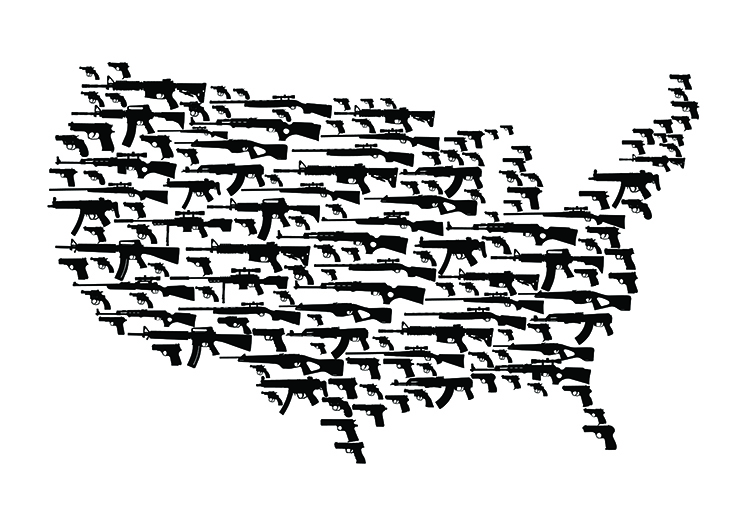
At any rate, marginal gun-control laws (such as background checks on private sales or bans on certain tactical features) are hard to enact, and a drastic reduction in Americans’ access to guns is politically, constitutionally, and practically off the table. America contains more guns than people, and nowhere near enough political support exists for the broad restrictions that would require a constitutional amendment. The guns aren’t going anywhere. As a recent New Republic headline dejectedly put it, “The War on Guns Is Lost.”
Perhaps those who don’t see gun ownership as an important constitutional guarantee of armed self-defense (we do) should think about it in similar terms as alcohol, which the Centers for Disease Control blames for 140,000 deaths per year, close to triple the number of firearm deaths, including suicides—as an ineradicable part of our culture, whatever its downsides, with regulators able to curb the worst aspects but not much beyond that.
We won’t tell gun-control advocates to stop fighting, and they wouldn’t listen if we did. But gun control cannot be the prime focus of our immediate efforts to stop the bloodshed in our cities.
It’s possible to reduce violence in a country with strong gun rights. We know this because the U.S. gun murder rate was at a near-50-year low as recently as 2014—and because the nation saw it fall dramatically in the 1990s and early 2000s as the number of guns in circulation rose. The precise mix of causes of the “great crime decline” are hotly debated, of course. But some clearly effective strategies included improved policing and the incarceration of the most dangerous offenders.
Why these approaches work is no great mystery. While gun ownership is widely distributed—increasingly so, with rises among women and racial minorities in recent years—gun violence is intensely concentrated, not just in particular regions and cities (as noted above), but among specific social networks, at specific “hot spots” within neighborhoods, and among individuals with previous criminal records.
Turning away from well-targeted policing and incapacitation while pointing fingers at conservatives’ gun laws is counterproductive. It’s also disingenuous, neglecting the role that enforcement plays in giving effect to any new restrictions added to the statute books should the Democrats suddenly get their way on gun policy. After all, what good are additional (presumably criminal) gun laws when police are actively discouraged from proactively seeking out violators? When “progressive” prosecutors offer large shares of violators diversion or plea deals, resulting in sentences of probation? When decarceration advocates work to make meaningful terms of imprisonment increasingly rare?
— Rafael A. Mangual and Robert VerBruggen in Gun Violence in Red and Blue